
Ogou: Fire, Love, and Revolution in Haitian Vodou
The Primal Fire
The origins of Ogou cannot be separated from the same currents of rebellion, transformation, and sacred contradiction explored in the figure of Gede Nibo. Where Gede Nibo stands at the threshold between life and death, gender and defiance, Ogou rises at the crossroads of fire and law, destruction and order. Carried from West Africa with the Yoruba tribe through the transatlantic slave trade, Ogou did not arrive in Haiti unchanged. Like all surviving spirits, he adapted. In Haitian Vodou Mythology, Ogou became more than a warrior: he became the intelligence of resistance, the discipline required to endure oppression, and the political consciousness necessary to overturn it. Just as Gede Nibo reveals how rebellion reshapes identity, Ogou reveals how power must be forged, tempered, and aimed if freedom is to be won and held.
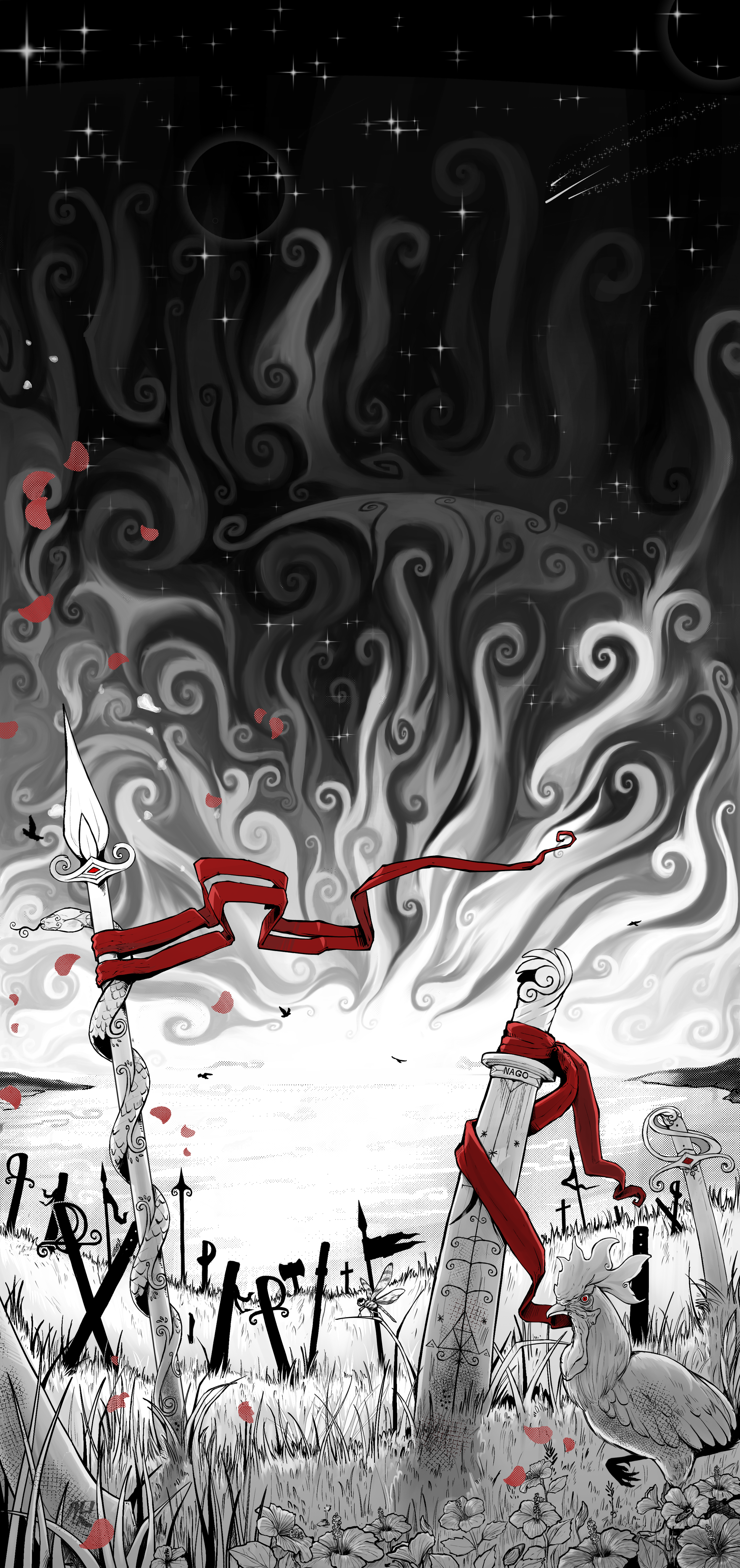
Ogou wallpaper
The Nago Nation announces itself with the salutation Aoche Nago, a cry that is at once a greeting, a summons, and a declaration of strength. From this call emerges the Ogou family—the many manifestations of Ogou who together express the full spectrum of Nago power: generals and soldiers, healers and strategists, judges, gatekeepers, and fire-bearers—each carrying a distinct aspect of the same primal force. These are but a few of the thousands of aspects and apparitions of Ogou.
“Sali Nago e !
Mezanmi men Nago rive
Li lè, li tan
Sali Nago !
Men se lè-l sa e!”
“Hello Nago!
My friend, Nago has arrived.
It's time, it's time.
Hello Nago!
It's time!”
Support the blog and the work behind it: get prints and stickers inspired by Haitian Vodou. This will help me to keep uncovering, writing and illustrating these stories
The Ogou Family
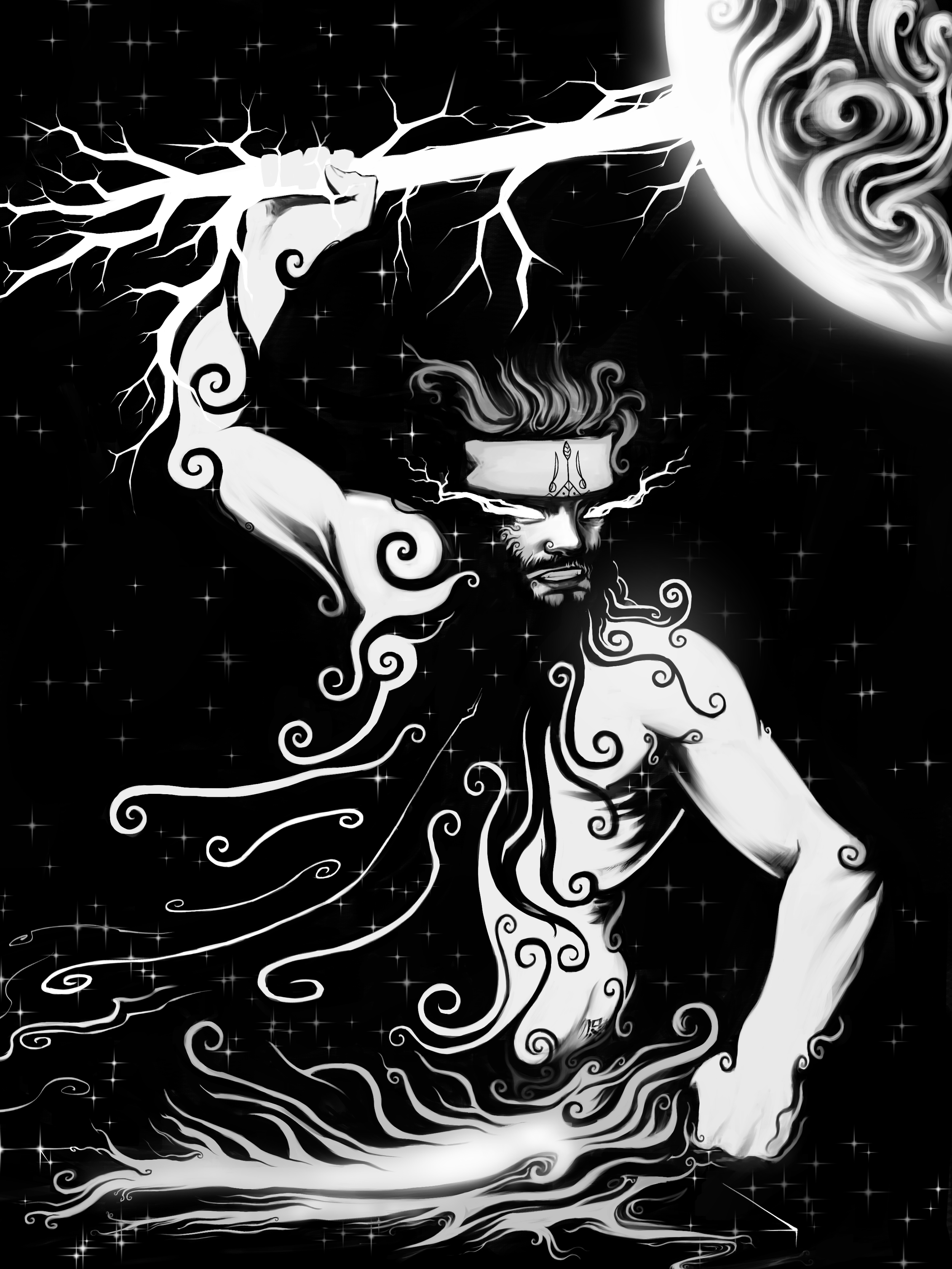
Ogou God forger
Ogou Batala
Ogou Batala is part of the army of Ogou loas and is considered the father of the Nago Nation, a spiritual lineage in Vodou known for strength, courage, and commanding power. Within this lineage, he stands not only as a leader, but as the origin of all Ogou spirits. Batala personifies the discipline of chaos, directing the cosmic traffic with his magic wand.
Because the Ogou are tied to war, diplomacy, leadership, and political order, Obatala is often regarded as a general. His role is not only to lead, but to teach strategy, endurance, and precision. He embodies discipline within chaos, the structure that holds power steady, and the clarity needed to survive conflict. As a master swordsmith, he crafts his own weapons, symbolizing that true authority must earn its tools and not borrow its force from others.
What makes Obatala extraordinary is his dual nature. He is hermaphrodite, both male and female, a spirit who carries the ability to create life from within his own being. In Haitian Vodou, Batala can bear the surname or epithet Megi (or Meyi), a Kreyòl rendering of Yoruba meji, meaning twins or a pair. This reflects the ability for Obatala/Batala to appear as either woman or man. He is often called Grann Obatallah, a title that recognizes his nurturing side, his role as creator, and the ancient wisdom he embodies.
Obatala teaches that leadership is responsibility, not dominance. He represents justice that does not waver, power that does not abuse, and creation that does not destroy without purpose. To honor him is to respect discipline, to defend with integrity, and to understand that true strength can hold both softness and fire.
Although this may, in a certain sense, be the most impressive manifestation, there are many other important Ogou. Each Ogou can strengthen the devotee in his or her own fashion. As Balendjo, Ogou is known as a healer, often showing particular concern for children and preparing herbal remedies. As Ogou Feray, he imparts strength to a serviteur by striking the arms, thighs, and back, as if to infuse that body with a portion of his own power. As Ogou Badagri, he may lift a person into the air and carry them, indicating special patronage. There is even an Ogou Bayé (barrier, gateway) and an Ogou Panama (straw hat), who as gate-guardians recall Legba.
Whatever the aspect, an Ogou always bears the special Nago mark of power and militancy. The idea of force, conflict, and power is almost inevitably linked to fire and heat. Ogou is a deity of fire, and red is the color sacred to him.
Ogou Badagri
Ogou Badagri is the son of Obatala and lives in the fire of heaven at the top of the mountain. Born in Badagri, Nigeria, the sun was in the 9th house of the zodiac at his birth. Badagri is as gentle as a lamb, as fierce as a dog that devours its prey. He kills when his protégés are in danger and fights in blood.
In Haitian Vodou, Badagri represents the power of the general: strategy, tactics, diplomacy, justice, and victory. As a spirit of justice, Badagri defends the innocent and oppressed. Promises made in his name must be kept, or consequences will follow.
By nature, Badagri is fiery and does not suffer fools. He is blinded by passion when it comes to defending the freedom and justice of his servants.
“Ogou Badagri se nèg politik O!
Ogou Badagri se nèg politik O!
Lè ou antrave se lese koule.
Ogou Badagri se nèg politik O!
Pa kite nèg touye ou.
Tanpèt mare, lanmè move
Ogoun Badagri se nèg politik O!
Glise koule, glise ale fè rout ou.
Ogoun Badagri se nèg politik 0 !"
“Ogou Badagri is a political man O!
Ogou Badagri is a political man O!
When you are hindered, let it go.
Ogou Badagri is a political man O!
Don't let a man kill you.
Stormy sea, rough sea
Ogou Badagri is a political man O!
Slip, slip and make your way.
Ogou Badagri is a political man 0!"
He is the husband of Erzulie Fréda, whom he loves with as much violence as he fights his opponents.
Fréda caused a quarrel between Badagri and Agwe. Agwe invited Badagri to a grand party at his palace in Trois Ilet . Agwe did the unthinkable, during the party, he accused Badagri of stealing his wife. Badgri got angry, and retorted back to Agwe:- who knows if you didn’t kidnap my daughter Ursule that drowned?. Agwe was foaming with rage and ordered his escort to attack Badagri. Badagri melted the cannonballs thrown at him with his fire, and with his saber, pushed aside the attackers. “Agwe’s fleet commanded by Master Ogou Balendjo was chasing Badagri. Guédé Nibo, who is part of Agwe's crew, was exultant. You should know that Badagri practically raised Nibo. And he too is in love with Freda. It was for this very reason that Badagri had to send him to live in the kingdom of the Gede. Badagri called upon Ogou Assôtor Michô for help, which arrived in the form of a two-meter-long drum that split the waters like a fish. Unfortunately for Agwe and his escort, the waves began to boil under the effect of Badagri’s fire allowing Badagri to escape safely.
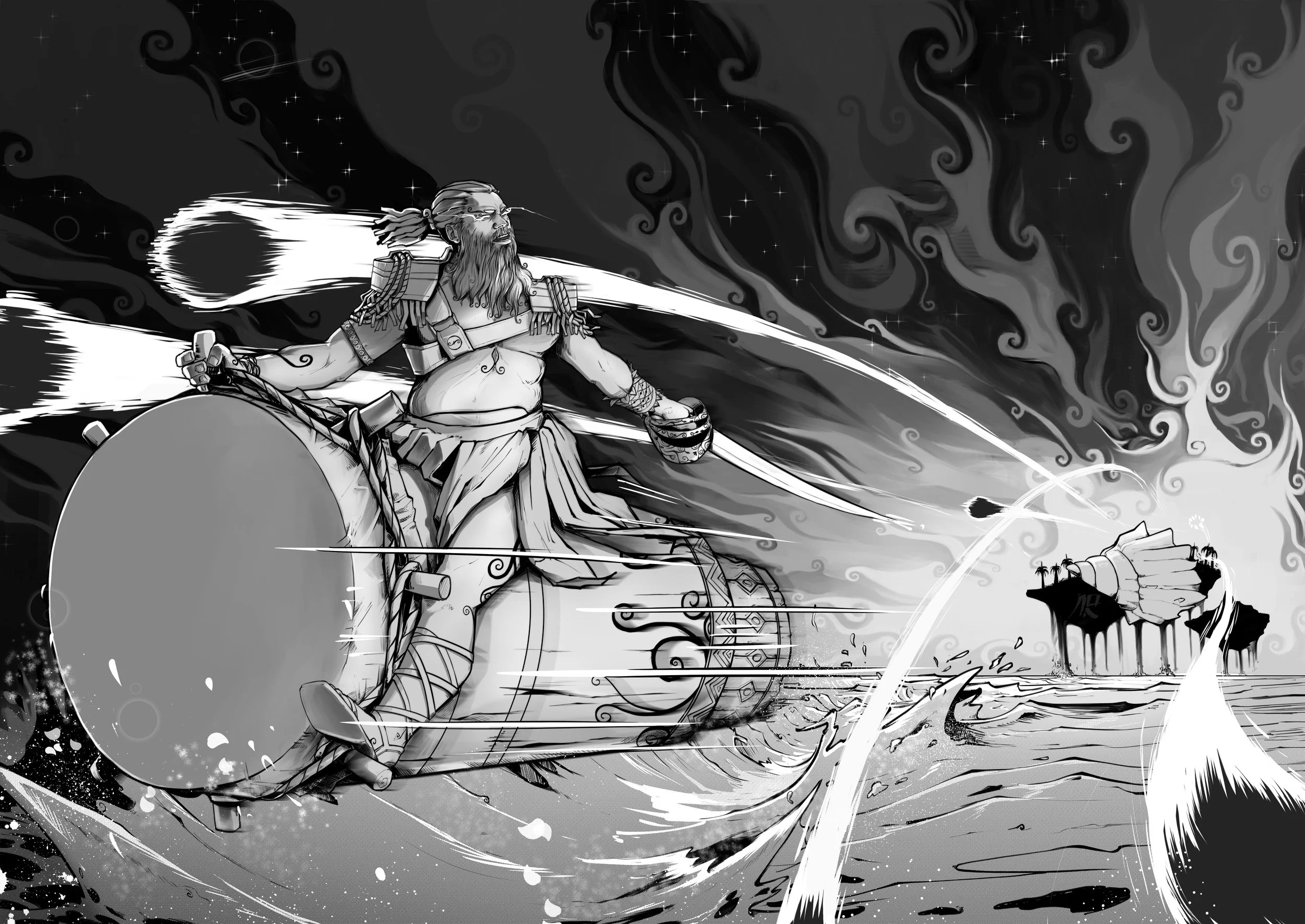
Badagri escaping Agwe’s escort on assotor
Ogou Balendjo
Ogou Balendjo is a water Ogou, or “wet Ogou,” part of Agwe’s escort. He lives on Agwe’s island at Trois Ilets and is from the Nago Nation. Balendjo speaks the truth but does not wage war like his cousin Ogou Feray. He helps all those who fight against slavery, serving the righteous and the wise.
"Balendjo Ogou Wa! Wa!
Se pa manje ranje ki pou touye chwal a Balendjo
M'achte kabrit mwen
M'achte bèf mwen
Se pa manje ranje ki pou touye chwal mwen"
"Balendjo Ogou King! King!
It's not the prisoned food that will kill Balendjo’s horse
I bought my goat
I bought my cow
It's not the prisoned food that will kill Balendjo’s horse"
Balendjo’s essence is spirituality. He grants unlimited power, asking only that one knows oneself and respects the laws of nature. In this way, he forms incorruptible disciples. He favors letters, arts, and poetry, avoids alcohol, uses fire for healing, and draws upon the rays of the sun where the essences of evolution are united.
He prefers coffee sweetened and with cream, following Agwe’s style. His symbols are the triangle and flags. Balendjo balances fire and water, navigating material and spiritual realms as captain of Immamou, Agwe’s ship, guiding souls back to Ginen, the ancestral homeland. He is quiet, intelligent, and humorous.
Ogou Feray
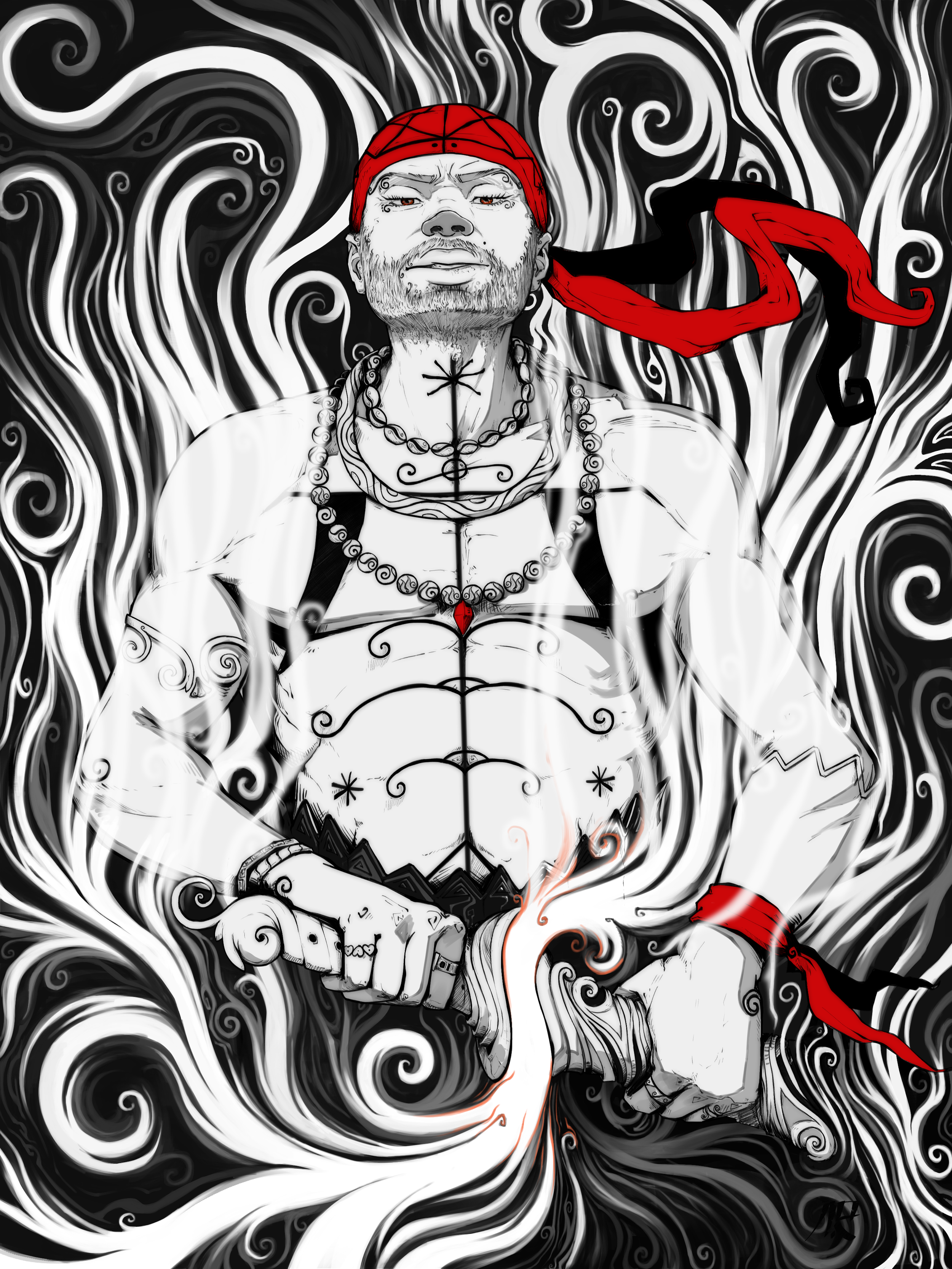
Ogou Feray
Ogou Feray is a spirit of fire, iron, and war. He fights for his servants to the last drop of blood and is the protector of the Bagji (Vodou temple).
“Feray O!
Nan min ki moun wap kite badji Loa yo?
Le m rete, m sonje Ogou Feray
Map konsole, map pran kouraj O!
M'ape rele Aleman Aleman Lèmiso
Loa kita Loa kita sobagji-m asire
m'a rele Ogou Feray Sobagji-m asire”
“Feray O!
In whose hands will you leave the Lwas badgi?
Sometimes, I remember Ogou Feray
I will console myself, I will take courage O!
I will call Aleman Aleman Lêmiso
Loa kita Loa kita sobagji-m assire
I will call Ogou Feray Sobagji-m assire”
Often conceived as the youngest Ogou, his temperament is unpredictable and emotional. His symbol is the red rooster, and he enjoys rum during celebrations.
Our Father who is in heaven, greater than Dambalah and the others, gave Feray the love of the woman as a punishment for stealing the sun's fire. Ay fout tonner! (Oh damn thunder!) Aoche Nago! He loves women. He consumes himself with love for them. And this punishment is great
“Ogou travay o
Ogou pa manje
Ogou travay
Ogou pa manje
Tout lajan Ogou fè
Se pou li pote bay fanm
Yèroswa Ogou dòmi san soupe.”
“Ogou works o
Ogou doesn’t eat
Ogou works
Ogou doesn’t eat
All the money Ogou makes
It’s to give to women
Yesterday Ogou slept without eating.”
Ossangne
Like Balendjo, Ossangne is a wet Ogou and the gatekeeper of the Nago rite. His power comes from age and experience. Severe yet just, Ossange is often portrayed as a beautiful old man. Not this dazzling beauty that makes the spine quiver, but this impression of well-being, of confidence. He wore a righteous one with an azure blue body tending to green. On his shoulders fell a long red cape, the color of the Nago, the spirit of fire.
He is known by many names: Ossangne Megui Bouleh, Galandye Guegui Maior, Monsieur Ossangne Aguenito, Aguelingui, Nègre Tangnifè Nago, Ossangne Aquiquan. He teaches that lost time can be recovered through will and faith. Living in the lower waters, he is the spirit of the ocean caves where initiates perfect self-control. He is the sage or houngan of Dambalah.
Ossangne’s symbols include a triangle surmounted by an airtight cross decorated with Legba’s circle. Aries' horns mark his zodiac, and Dambalah’s snake undulates from the triangle’s base to the crossbar. The Bet a Leza, symbol of Agou, replaces the neck. These symbols reflect the law of sympathy or attraction.
Ossangne is also a healer, stocking medicinal leaves in the woods for his devotees.
'Osany O! Lamizè pa dous o!
Osany o! M'di mèt Osany lamizè pa dous
M'pral chache lavi yon lòt kote o!'
'Osany O! Poverty is not sweet oh!
Osany o! I tell you, master, Hosany poverty is not sweet
I will seek life elsewhere oh!'
Shango
Shango is from Nanchon Nago but is often served under the Petro rite. His day is Wednesday, like all other Ogou and his color is red. He wears a general’s necklace, said to contain 21 Loa.
Shango is venerated for his power over lightning and fire, symbolized by a double-edged axe, representing the duality of life and justice. According to Yoruba oral tradition, he was the fourth Alafin (king) of the Oyo Empire around the 12th century, known for extraordinary strength and fiery temperament. He could project fire and lightning from his mouth, a gift that led to his downfall.
Although originally a Yoruba orisha, Shango’s worship is integrated into Haitian Vodou, sparking revolutionary fire during the transatlantic slave trade. Rituals honor him through nature—trees, stones—as receptacles of his power. He is sometimes associated with a garde and is considered a powerful loa, though less frequently invoked in formal rituals.
Ogou, Love, and the Fire of Erzulie
The Ogou forces are not opposed to love or sensuality; these qualities are sources of ignition. In Haitian Vodou, the descent of Ogou is marked by the swordstroke of Ogou: the moment when the lwas of fire pass from the upper realms into material existence. This descent occurs through a fissure symbolically shaped like the female sex organ, represented by Erzulie.
The Ogou bear the fire of heaven, or the luminous fire of the creator forged into iron, blade, and serpent. This fire moves across the earth as a living current, sowing movement, intellect, conflict, and transformation. In ritual, the swordstroke is reenacted when flagbearers kiss the tops of the flagpoles in some ceremony.
Each apparition of Erzulie shapes Ogou’s fire differently. With Erzulie Fréda, it becomes diplomacy, political intelligence, seduction, and ambition. With Erzulie Dantor, the fire hardens into resistance, protection, and righteous violence born from wounded love. The tragic Erzulies of jealousy and abandonment carry a volatile heat; they worship fire because it mirrors their nature: beautiful, consuming, and dangerous when constrained.
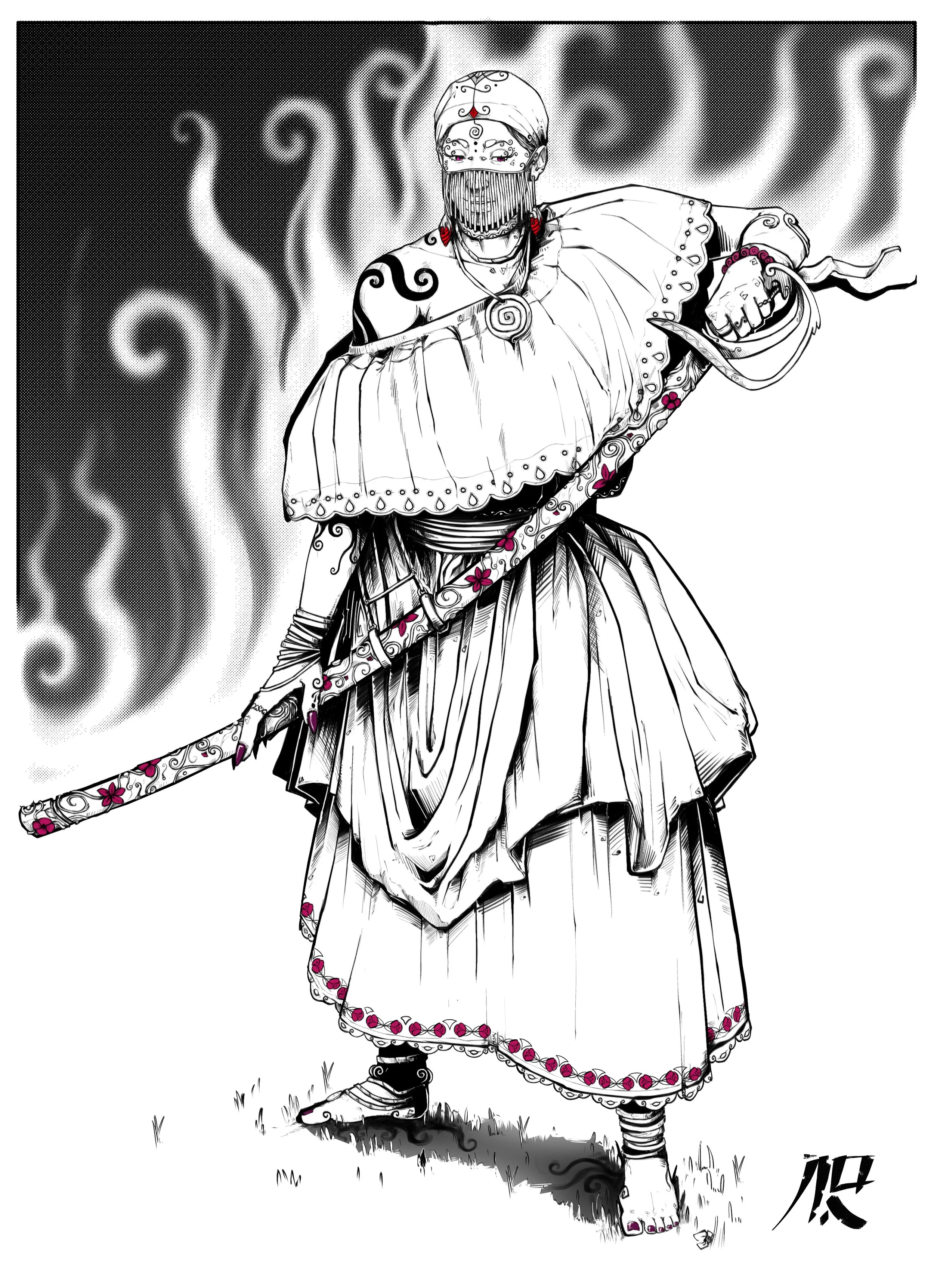
Tragic erzulie.
During the Haitian Revolution, these Erzulies did not remain symbolic. They fought alongside Ogou as artillerywomen, couriers, and women who used intimacy as instruction and strategy. Offerings of alcohol mixed with pepper, tafia blended with gunpowder, and the heart pierced by Ogou’s dagger illustrate a truth Vodou never hides: love and war are not opposites.
How the Ogou Lwas shaped Haiti’s Independence
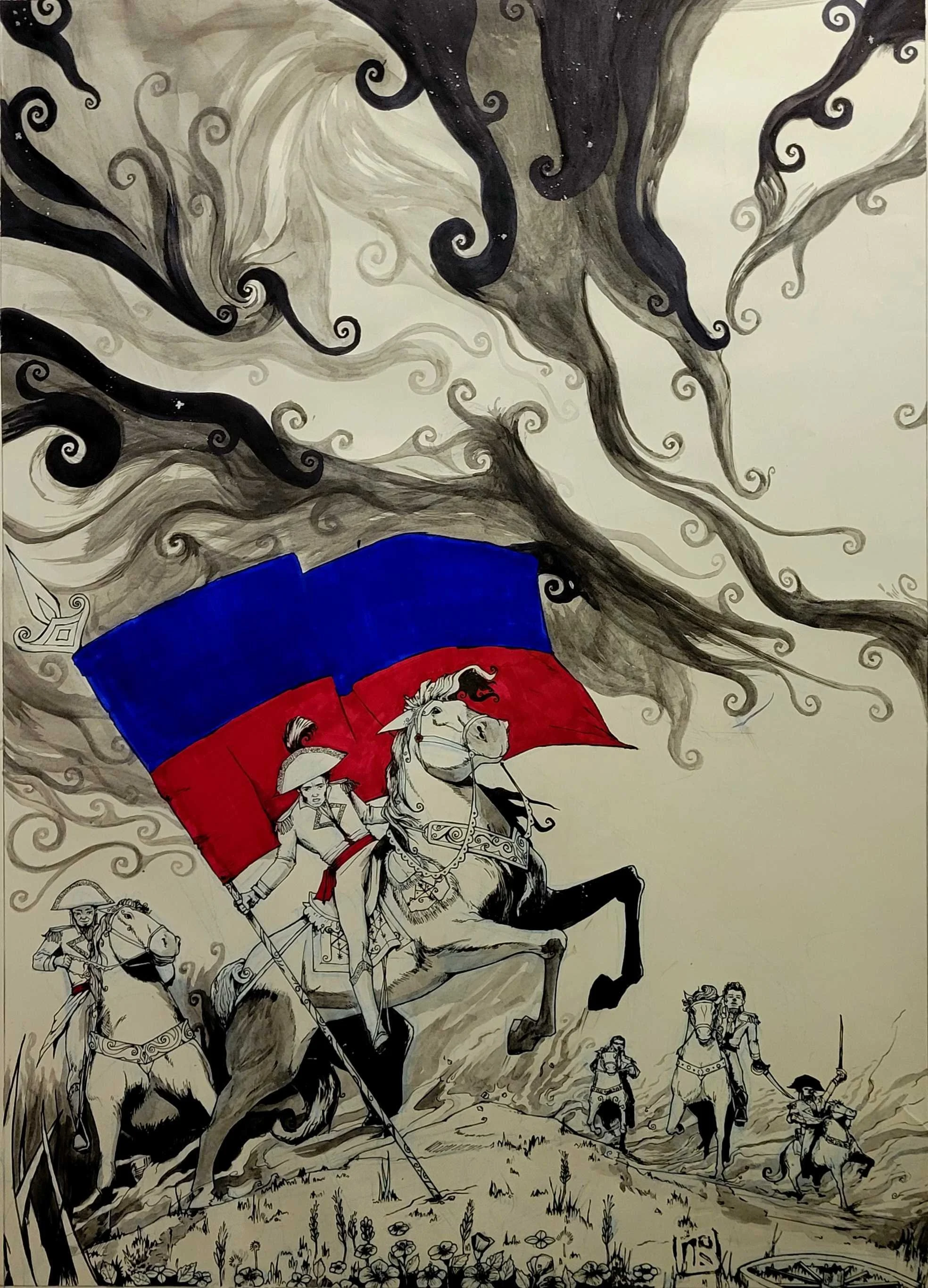
Haiti independence day Heroes
January 1st mark for Haitians a triple celebration; the new year, the independence of Haiti and the yearly making and sharing of Soup Joumou ( pumpkin stew/soup). Vodou and subsequently the Ogou played a central role in Haiti’s Independence. The Ogou lwa did not merely symbolize the Haitian Revolution—they organized its spirit, discipline, and fire. They were living principles embodied by generals, soldiers, healers, strategists, diplomats, and visionaries, fighting slavery on both physical and spiritual planes. Popular tales tell that Dessalines was possessed by Ogou when he cut the French flag to create Haiti’s flag, a moment that symbolized both divine guidance and revolutionary fire.
Revolution is born through Erzulie—the wound, the desire, the violated body—and armed by Ogou. The tragic Erzulies who fought as generals, artillerywomen, sex workers, ect... were not peripheral; they were initiators of revolutionary fire, turning intimacy, jealousy, and pain into weapons.
The Ogou lwa shaped a revolution that was military, spiritual, political, and cosmic. Haiti did not merely rebel—it re-founded the world, becoming the first Black republic and the first nation born from a successful slave revolution.
Support the work — Own a piece inspired by Haitian Vodou Mythology
“A deep look at Ogou, the lwa of fire, war, and political power in Haitian Vodou, and how his force, paired with Erzulie, shaped love, resistance, and Haiti’s independence. Includes the rituals, family of lwa, and sacred fire.”
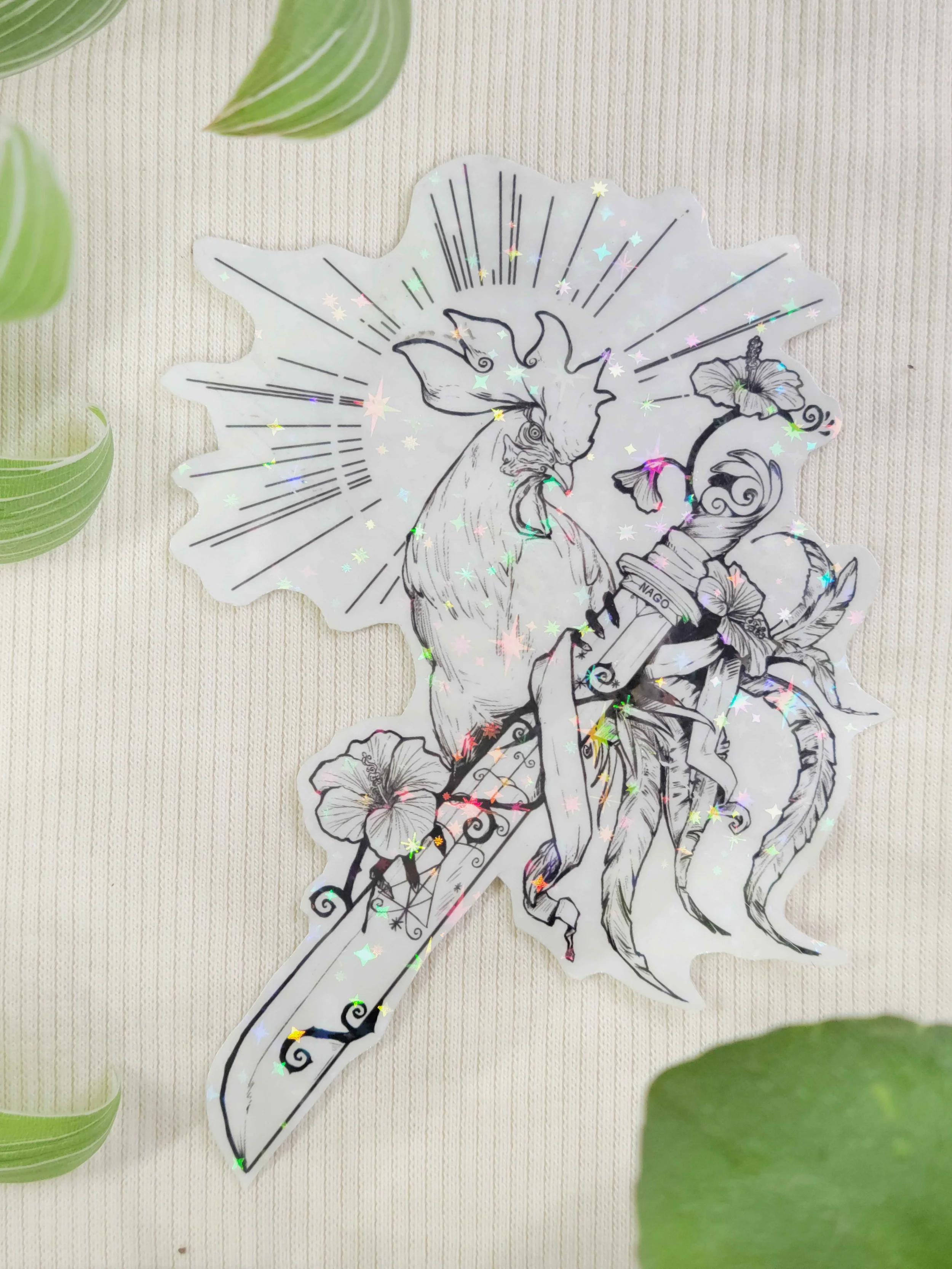
4’’ water resistant sticker
Made with HTVRONT printable glossy vinyl paper
Laminated with Bleidruck self laminating paper
Handcut
Inspired by haitian vodou mythology.
Ogou Feray is a spirit of fire, iron, and war. He fights for his servants to the last drop of blood and is the protector of the Bagji (Vodou temple). The rooster is his symbol
Use code "PRINT50" for $10 off any order
〰️
Use code "PRINT50" for $10 off any order 〰️
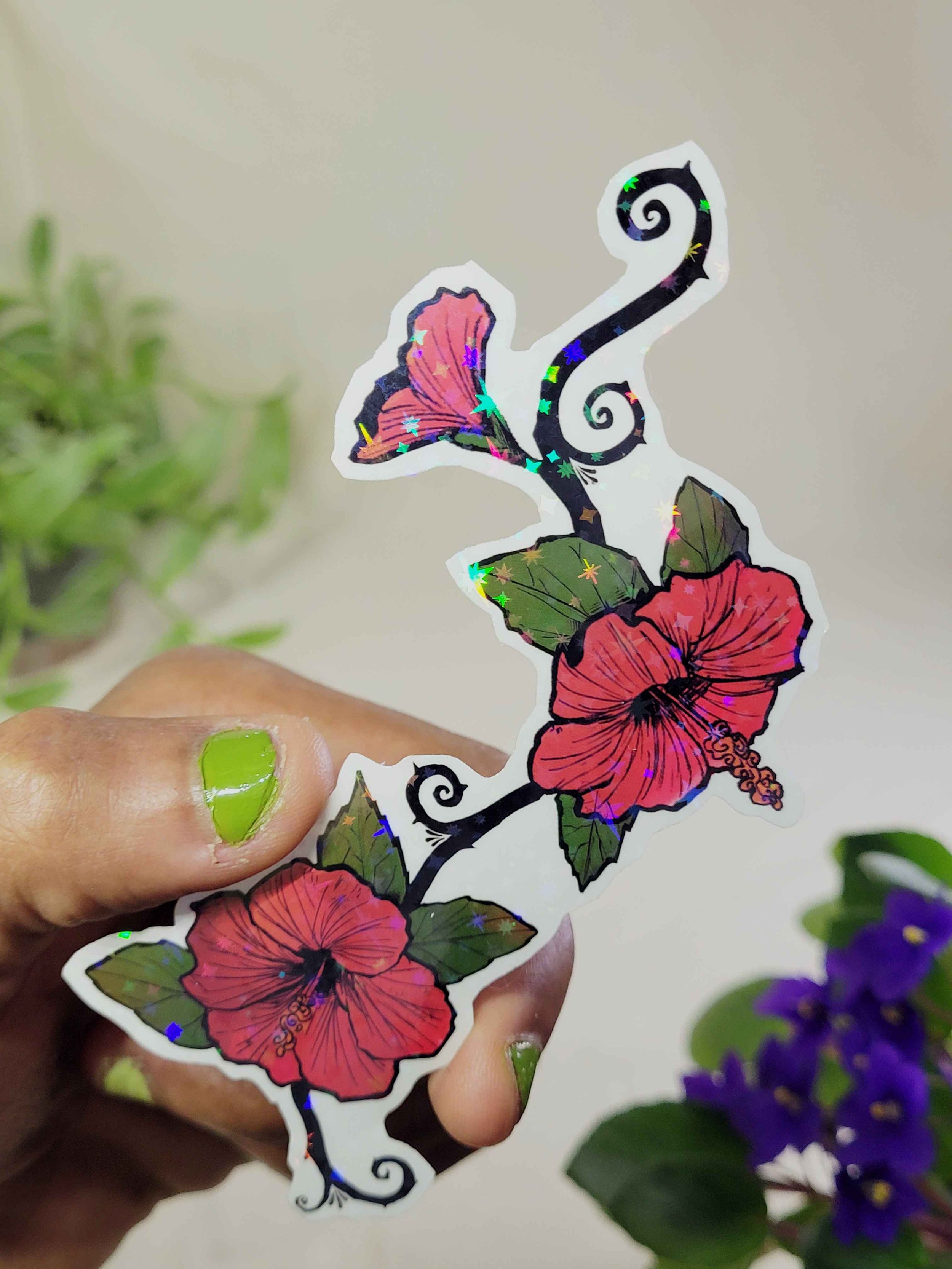
4’’ water resistant sticker
Made with HTVRONT printable glossy vinyl paper
Laminated with Bleidruck self laminating paper
Handcut
Inspired by haitian vodou mythology.
The hibiscus flower is often considered as haiti unofficial flower. Often usen in tourism ads, it represents the vibrancy of the island as much as a flower can convey that.
“AOCHE NAGO!”
